The Autumn Swell Run
The Atlantic coast is at its best after everyone has gone home. Six nights from North Devon into Cornwall, on two bases, in the good season.

David O4 min read
6 nights460 miOctober
Open the planThe summer version of this coast involves a queue for the car park at Croyde and a beach with more people on it than water. The autumn version is the same coast with almost nobody on it, warmer sea than you get in June, and the swells that the whole place is actually famous for. It is the same drive, the same beaches and a completely different week, and the only thing that changed was the date on the booking.
The sea does not run on the school calendar
Two things move out of step with the holidays, and both of them move in your favour.
The sea is at its warmest in late summer and early autumn, not in midsummer, because water takes months to catch up with air temperature. September sea is warmer than June sea, reliably, everywhere on this coast.
And the swell improves. The Atlantic starts producing consistent groundswell as autumn depressions get going, which is why the surf competitions on this coast cluster in autumn rather than August. Summer on the north Devon and Cornish coast is frequently flat, which is fine if you came to sit on a beach and disappointing if you brought a board.
Put those together and the season the tourist industry treats as the end of the year is the season the coast is best at what it does.
The shape of it
The version this comes from is North Devon & Cornwall Coast, six nights across two bases.
Two nights near Braunton in North Devon, working Saunton and Croyde. Saunton is three miles of north facing beach break with a large car park at the main entrance, though the plan flags checking the height barriers before committing a tall van to it. Croyde is the reef-backed bay, hollower and better suited to people who know what they are doing, with Baggy Point walking out above it towards Lundy on a clear day.
Then south into Cornwall for four nights on one site near Camelford, which puts Bude, Widemouth, Trevose Head, Padstow, Polzeath and Port Quin all within about forty minutes.
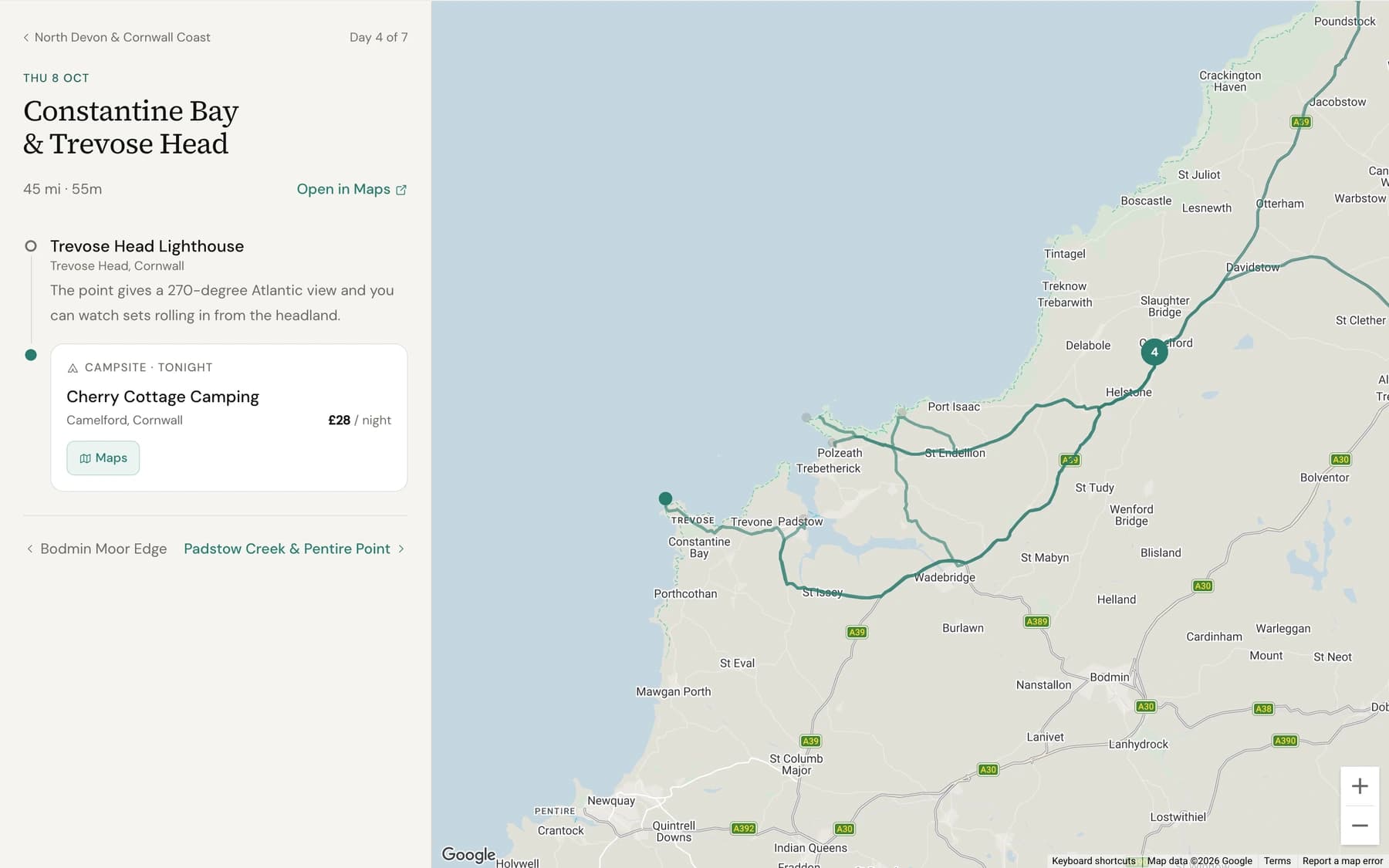
The Cornish days run at forty five, forty, and thirty five miles. Nothing on this trip is a driving day once you are down there, which is what having two bases buys you.
Bases rather than a coastal crawl
The instinct on a coast like this is to work along it, a night here and a night there, following the road south.
It is a bad instinct in autumn specifically, and the reason is the surf. What you actually want is to be able to look at the forecast in the evening and go somewhere different in the morning, which requires being within reach of several breaks facing different directions rather than being committed to whichever one is nearest tonight's pitch. From the Camelford base, Widemouth faces one way, Constantine and Trevose another, Polzeath is tucked in behind a headland. On a day when one is unrideable, another usually is not.
Packing up every morning removes exactly that flexibility, and adds an hour at each end of the day when the light is already getting short.
The practical bits
Tides matter more here than almost anywhere else in the plan. Several of these places change character completely between high and low water: Bossiney and Port Quin at the smaller end, the sandbars at Croyde. Check a tide table before deciding what a day looks like, not after.
Wetsuit thickness goes up as the season goes on. September water on this coast is comfortable in what you wore in August. November is not.
Parking is the recurring van problem on this coast, and height barriers are the specific version of it. Beach car parks are frequently barriered at around two metres, which excludes most conversions. The larger overflow fields tend to be the answer and they tend to close at the end of the season, which is one of the few things that genuinely gets harder in autumn. Where you sleep needs more thought here than in most places.
Drying is the other one. A wet wetsuit in a van in October is a fact of life rather than a solvable problem, and the trips that work are the ones where somebody thought about where it is going to hang.
When exactly
September and early October is the sweet spot: warm water, improving swell, sites still open, the crowds gone. From late October the sites start closing and the weather stops being reliable, though the surf keeps improving for anyone prepared to be cold.
August is the version everyone else takes, and it is the worst of it. Warm air, flat sea, full car parks. There is more of this coast worth the same treatment.
Written from a plan
Open the North Devon & Cornwall Coast plan, or make your own.
This note was written from a plan made in Quiet Route. Start your own from it and your brief opens with North Devon District in it.
Your first trip is free, then £28 a year. Full refund within 14 days if you bought on the web.