Scotland begins about two hours north of Manchester and almost nobody stops there. The van crosses the border, the road opens up, and the plan is Glencoe or Skye or the top of the country, which is another four or five hours yet. Somewhere off to the left is a forest park the size of a small county with the darkest skies in Britain in it, and the overwhelming majority of vans heading north have never turned off to look.
The problem is that it is on the way to somewhere else
Galloway suffers from geography. It sits at the point in the drive where you have just started and are not ready to stop, on the wrong side of the country from the routes everyone has heard of.
The famous names do the rest. A first trip to Scotland gets planned around the things people already know, which means the Highlands, the islands, and the coastal route everyone has seen photographs of. None of those are mistakes. They are just a long way further, and choosing them means treating the first two hours of Scotland as something to get through.
The practical consequence is that a region with a Gold-tier dark sky park, several hundred square miles of forest and a coastline nobody queues for is quiet in August. Not empty, but quiet in a way that the west coast has not been for years.
What is actually there
Galloway Forest Park is one of the largest forest parks in Britain and was the first place in the country to be designated a Dark Sky Park. It holds Gold tier status, which is the highest available and requires genuinely minimal light pollution rather than merely dark countryside. There are only a handful of Gold-tier sites in Europe.
That designation is the thing worth planning around, because it is a resource with an opening season rather than a permanent feature. It is useless in June, when Scottish nights barely get dark at all, and it is at its best from late September onwards. An autumn trip here is not a consolation for missing summer. It is the correct time to come.
The rest of it is forest, hills and water. Clatteringshaws Loch sits in the middle of the park with the Dark Sky Discovery Centre on its shore. Murray's Monument stands above the treeline at Talnotry with a view across the forest interior. Glentrool is the walking end of it. And on the coast, Caerlaverock Castle is a triangular medieval ruin inside its own moat, which is not a shape any other Scottish castle takes, with a saltmarsh nature reserve next to it that fills with barnacle geese arriving from Svalbard for the winter.
Four nights, planned
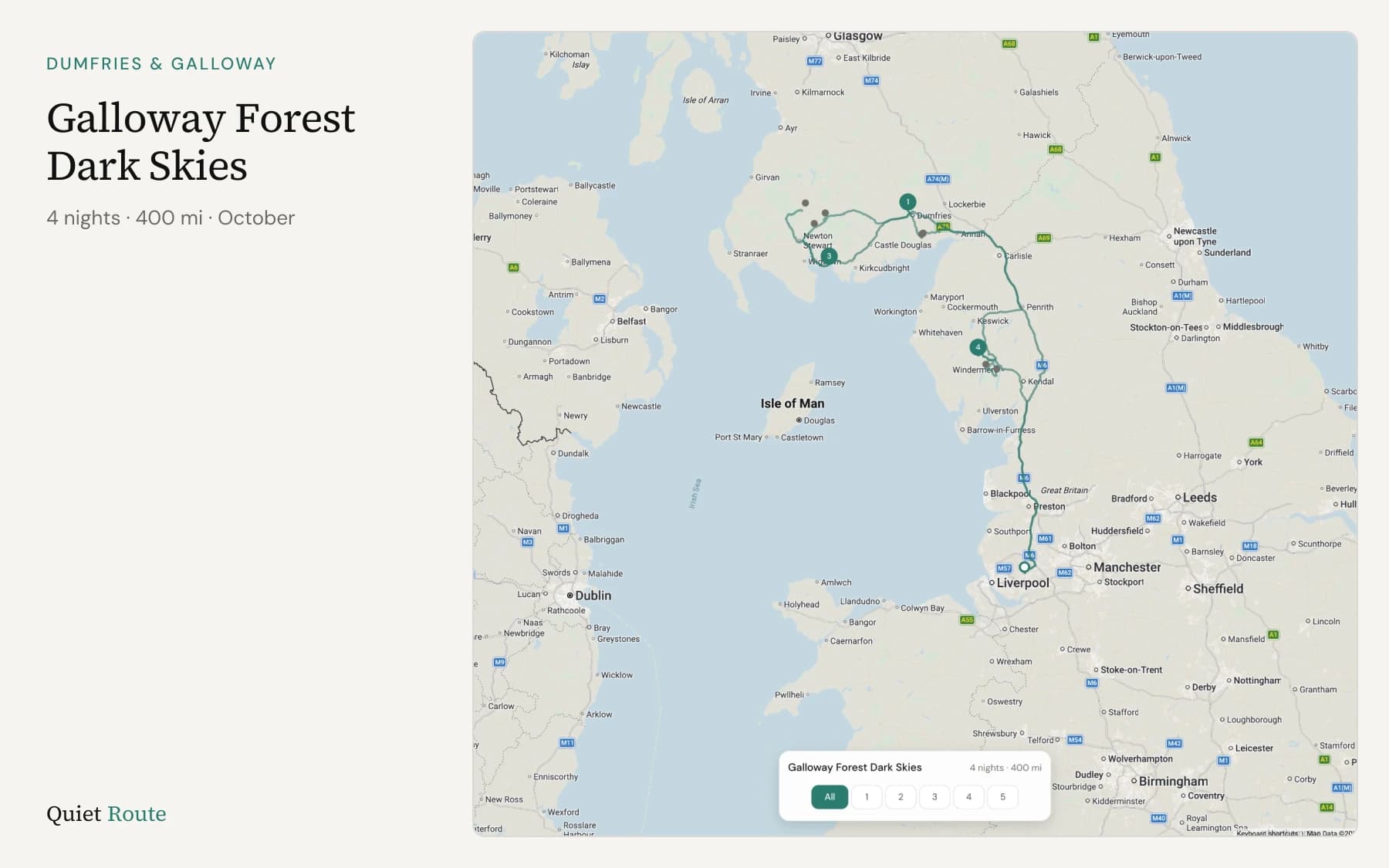
Here is the version this comes from: Galloway Forest Dark Skies. Four hundred miles all in, which for a Scottish trip from the north west is remarkably little.
Day one is the drive up, about a hundred and sixty miles, arriving on the coast rather than in the forest. Caerlaverock castle and the reserve, then a night at a site outside Dumfries. Starting on the Solway rather than pressing on inland means the first day ends with something in it other than driving.
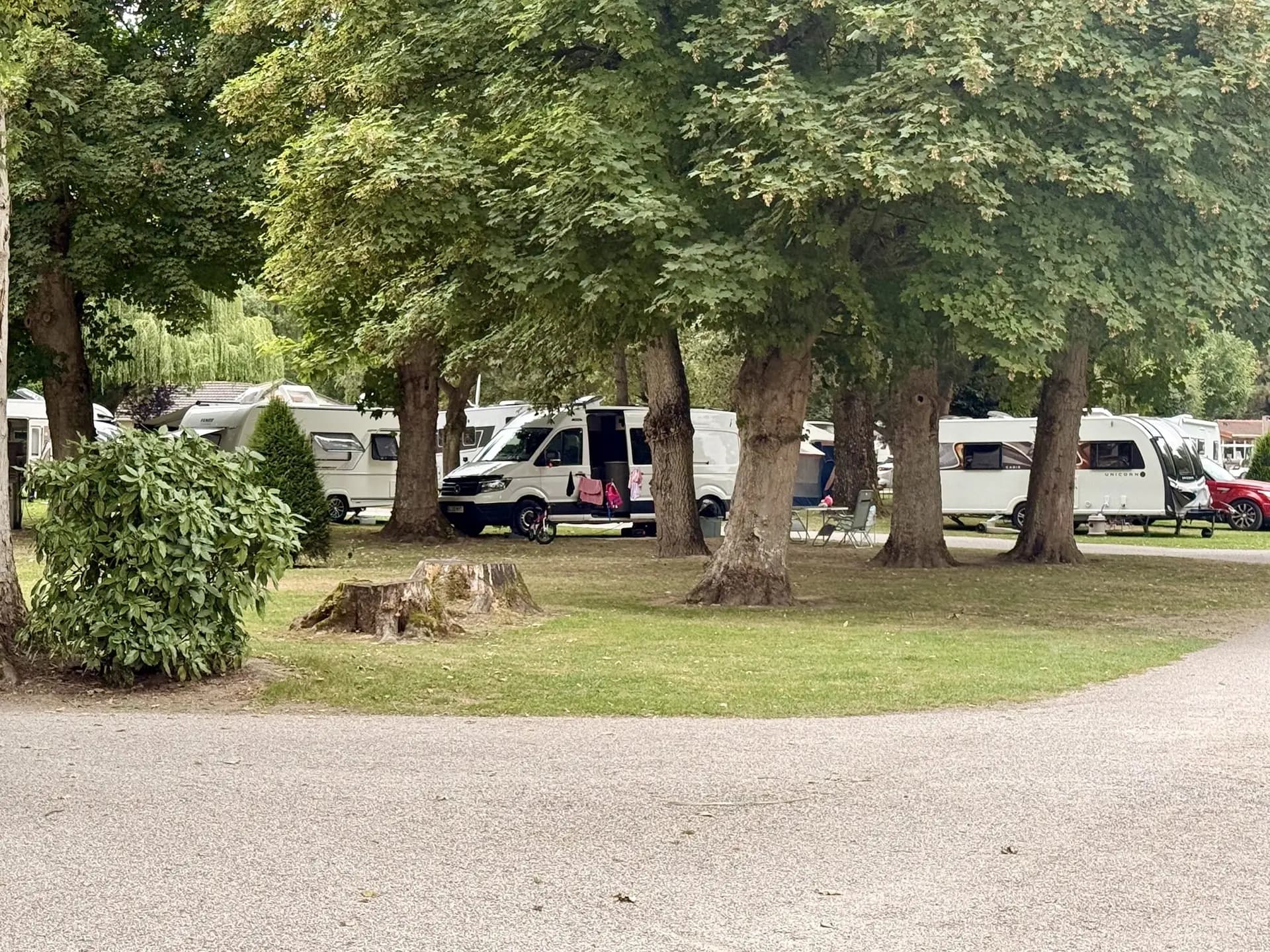
Day two moves inland into the forest, fifty five miles by way of Clatteringshaws and Murray's Monument, to a small farm site near New Galloway. This is the night the dark sky park is for. Where you sleep in Galloway is worth reading up on before you go, because Scotland's rules are not England's.
Day three does not move at all. One place, walking, and Glentrool. On a four-night trip that is the day the whole thing is built around, and it costs no driving whatsoever.
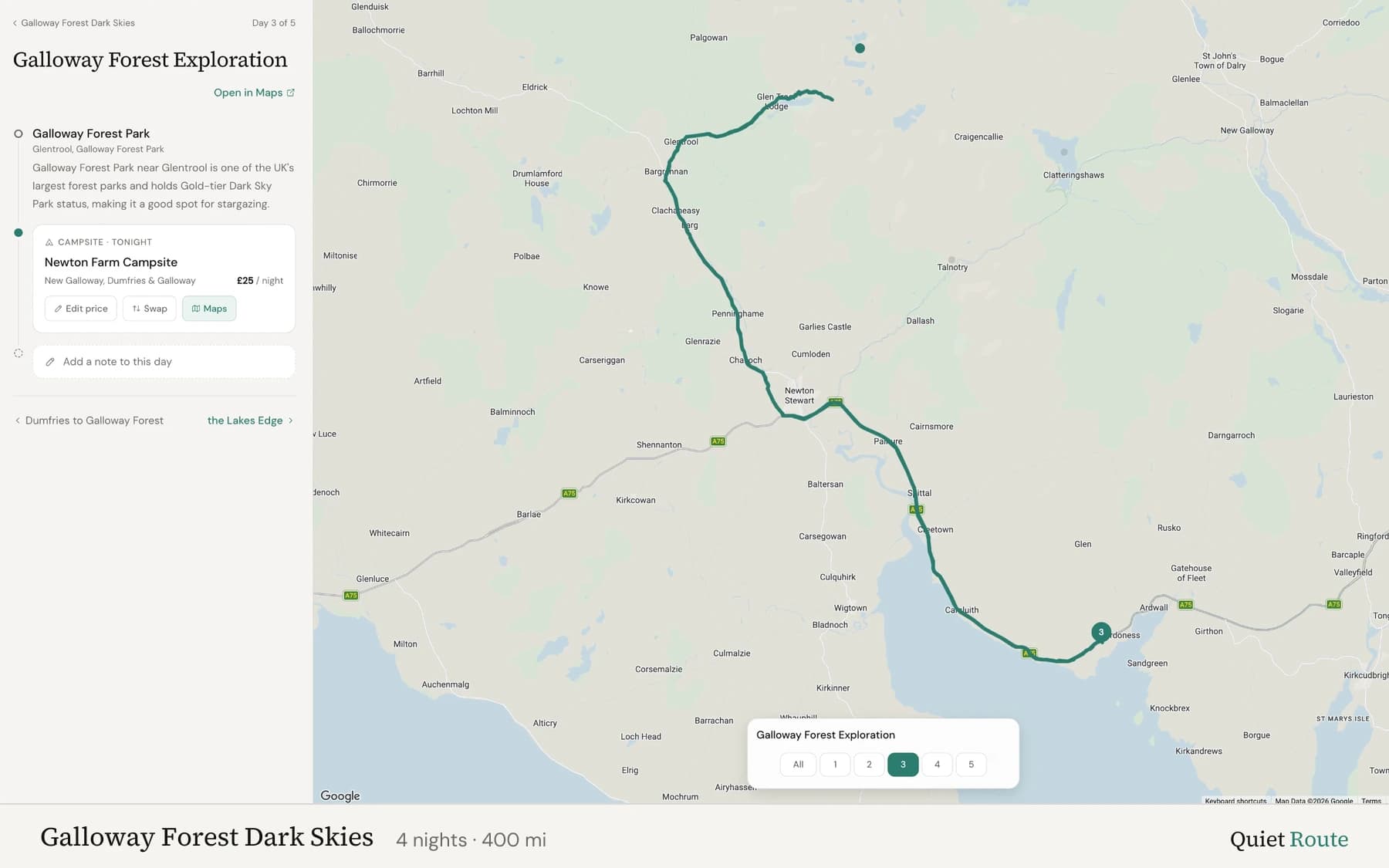
Day four leaves Galloway and stops in the Lake District rather than driving straight home, with Tarn Hows and Claife Heights on the way to a night in Great Langdale. Day five is ninety five miles home.
The return leg is doing something
That Lakes night is worth pointing out because it looks like padding and is not.
The drive from Galloway to the north west is short enough that it can be done in one go without much difficulty. Splitting it means the last day of the trip is a short drive rather than a long one, and it converts the journey home from an ending into another night away. On a trip where the total mileage is already modest, the extra stop costs almost nothing and buys a whole evening.
It also solves a problem that catches people on short Scottish trips: the sense that half the holiday was spent in the van. Four hundred miles across five days, with a full day that involves no driving at all and a return leg broken in two, is a very different experience from the same region reached in one push and left in another.
When to come
Autumn, if the dark skies are the reason, and they should be at least part of the reason. From late September the nights are long enough to be properly dark, the forest is turning, and the summer visitors have gone back to work.
Summer works if the walking is the point, though you will not see much of what the Gold tier designation is for. Winter is genuinely good on the Solway coast, when the geese are in, provided you check what is open before relying on it.
What does not really work is treating Galloway as a stop on the way somewhere else, which is the mistake the whole region has been quietly enduring for years. It is two hours from the north west. It deserves the four nights rather than the forty minutes.
The plan you keep meaning to make.
Plan my trip£28 a year. Full refund within 14 days if you bought on the web.
Now and then, by email.
A new note when one is published, and a word when Quiet Route changes. No more than twice a month.