Planning a trip you'll take in seven months
A trip in May needs a handful of decisions made in October and almost nothing else. Knowing which handful is the whole skill.

David O4 min read
By March the sailing you wanted has no cabins left on it. Seats, yes. There is a crossing two days later that still has a cabin, which moves the ferry, which moves the fortnight you have already booked off work. None of this was fixable in March. It was fixable in October, when the trip was a note on a phone that said France, maybe, two weeks in May, and there was obviously nothing useful to be done about it yet.
Seven months is long enough to plan badly twice
There are two ways to get this wrong and most people manage one of them.
The first is to treat the whole trip as urgent. Seven months out, you sit down and fix all of it: the crossing, every site, the route, what you are doing on the second Tuesday. It feels responsible. What it produces is a plan you will spend the next seven months slowly renegotiating with yourself, because your dates shift by a day, or you decide you want longer in one place, and every one of those adjustments now has a booking attached to it.
The second is to do nothing, on the reasonable grounds that May is a long way off and there is no information available yet. This works fine for about four months and then stops working, quietly, without telling you.
The useful version is neither. It is knowing which small part of the trip is genuinely scarce, dealing with that in October, and leaving the rest alone.
Only some of it is actually scarce
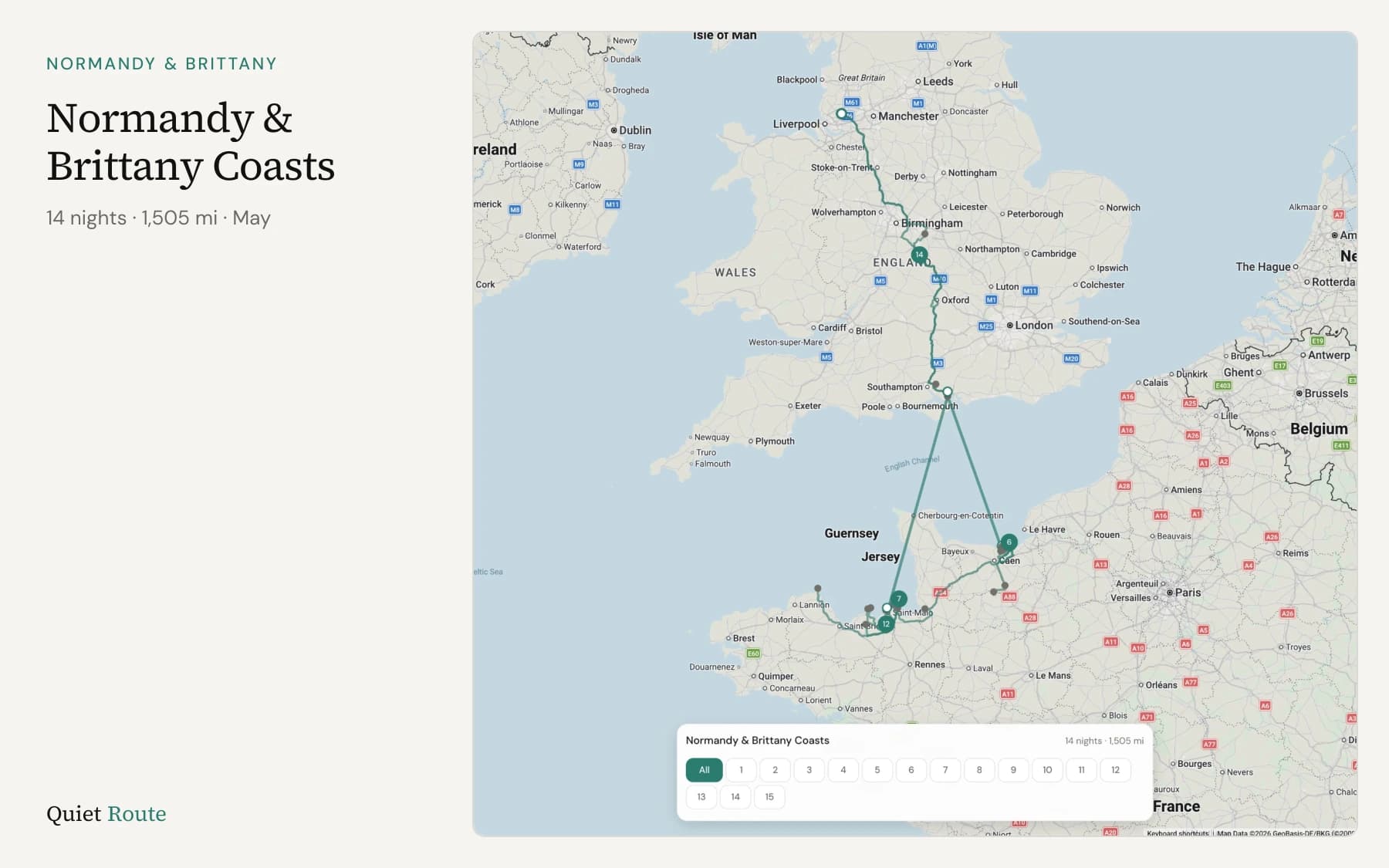
Take a real example. Fourteen nights in Normandy and Brittany next May, planned as Normandy and Brittany in May. Fifteen hundred miles all in, five hundred of them in England before the trip properly starts.
The whole thing has two decisions in it that belong in October, and they are both the same decision: the crossings. Out of Portsmouth to Caen, six and a half hours, overnight on board. Back from Saint-Malo, ten and a half hours, also overnight. Around five hundred and fifty pounds for the pair.
Those are the scarce items, and not simply because ferries fill. It is the cabins. An overnight crossing without a cabin is a different and considerably worse trip, cabins are a limited number of rooms on a specific sailing, and they go first on the popular dates. Booking the sailing in March and finding the cabins gone means either a night in a reclining seat with the family or moving the entire trip by a day, which moves everything else with it.
The crossings also fix more than themselves. A ten and a half hour sailing from Saint-Malo determines what the last day in France looks like. An overnight arrival at Caen determines the first. From the north west, getting to Portsmouth at all is a day's drive, which is why the trip has a night in Warwickshire at each end: not a destination, just an honest acknowledgement that three hundred miles and a ferry check-in do not fit in the same morning.
Fix that, and the trip has a spine.
The rest can wait, and should
Fourteen nights in that plan involve five different places to sleep. Four nights based near Cabourg, five near Dinan, the Warwickshire stopover twice, two nights on a boat.
Five bookings. In May, in France, on sites that are open but not yet busy, those are not scarce in any meaningful sense. You could book them in February. You could book most of them a fortnight before. Booking them in October buys nothing except a set of commitments you will have to unpick if the weather forecast in May suggests going west instead of east.
This is the shape most European trips have, and it is worth noticing: the transport is scarce and the accommodation mostly is not, which is the reverse of how it feels when you are planning. The ferry is one booking that is easy to make and easy to overlook. The sites are eleven decisions that feel like the work and can nearly all wait.
What the seven months are actually for
Not planning. Once the crossings are booked, the sensible thing to do with the months in between is very little.
What they are good for is reading the plan a couple of times when you are not in a hurry, and working out which parts of it are yours. Two of the days out of Dinan run to a hundred and ninety and a hundred and fifty miles, which is what it costs to get out to Cap Fréhel and Fort la Latte and back, or along the coast east of Saint-Malo and back. Those are proper days out. Some people would take both without thinking about it. Others, by the second week, would rather have one of them and spend the other afternoon on the river at Dinan doing nothing in particular.
There is no correct answer to that and nothing can work it out on your behalf, because it depends on who is in the van and how they feel about a long drive on day ten. What it does depend on is somebody actually looking at the week and deciding, which is a thing you can do at a kitchen table in October in about five minutes, or not do at all and discover in France.
That is the real argument for planning early. Not that everything is settled. That the trip exists in a form you can hold up and look at, months before it happens, while every part of it that is not a ferry is still costless to change.
Book the crossings. Leave the sites. Read the shape of it once or twice between now and May, and make it yours while making it yours is free.
The plan you keep meaning to make.
Plan my first tripYour first trip is free, then £28 a year. Full refund within 14 days if you bought on the web.