You can come off the ferry at Calais on a UK guide's advice and within an hour see things the guide hasn't prepared you for. A round sticker in half the windscreens you pass. A numbered bay in a village square with a water tap and a drain set into the kerb. A toll booth that takes a card and doesn't tell you the rate. France isn't the continent in general, and it isn't a bigger version of Cornwall. It has a system, and it assumes you already know how to use it.
UK guides treat France like a bigger version of Cornwall
Most of what gets written in English about campervanning in France is written for people who haven't been. The coverage is basics: ferries, driving on the right, the line about wild camping being tolerated in some places. The mechanics get skipped.
France has spent thirty years building the most developed stopover network in Europe. Several thousand aires across the country, with the system assuming you already know how to use it. The infrastructure wasn't built for tourists, which is partly why nobody has translated it.
Sitting alongside the aires is a paperwork layer that catches UK drivers out. Crit'Air stickers in low emission zones. Tolls that quietly add eighty quid to a return leg if you take the péage all the way. Speed limits that drop when it rains. None of this is obscure. It's just not what gets written about.
What follows is the practical layer. The mechanics, not the brochure copy.
The aire system is the country's big idea
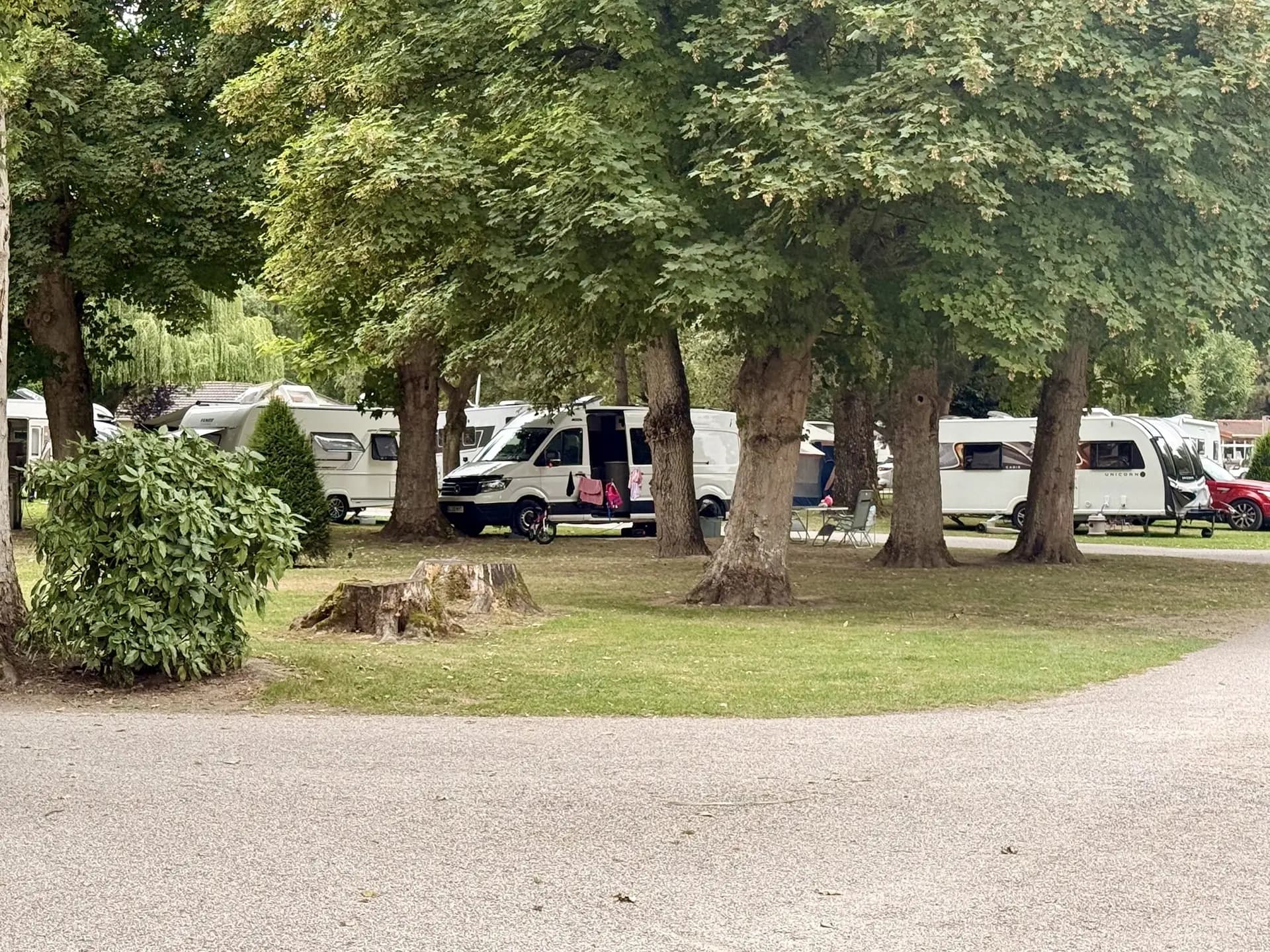
An aire de service is a municipal stopover for motorhomes and campervans. Some are free, most charge between five and twelve euros a night, and they're everywhere. Villages build them to bring visitors in. A typical aire has space for six to twenty vans, a service point with fresh water and grey waste disposal, and sometimes electric hook-up. The nicer ones sit on a riverbank or next to a market square. The plainer ones are a gravel rectangle behind the supermarket. Both are legitimate.
How it works in practice. You arrive in the afternoon, park up, and there's usually a machine that takes a bank card. Some still use honesty boxes. A night, a fill of water, an empty of waste, and you're off in the morning. No booking, no site manager, no six-month-ahead reservation dance.
The culture is self-policing. Aires are not campsites. Awnings out, chairs and tables set up like a garden, washing lines strung between vans is campsite behaviour, and it's the kind of footprint British vans most often get noticed for. The convention is to pull in, keep things small, and leave the bay as it was. Worth knowing before the first night.
Parking in towns isn't the same thing. A painted bay in a French village square might be a designated motorhome spot. If the sign shows a camping-car silhouette and a maximum stay, it's yours overnight. If it doesn't, it's a parking space and not an overnight one. The distinction matters when a gendarme takes an interest.
Wild camping is more nuanced than UK guides suggest. Sleeping in a layby, a beach car park, or a forest edge is technically tolerated in much of France but not everywhere. Signs reading camping interdit or stationnement interdit la nuit mean no. Beachfronts near Mediterranean resorts in August are heavily enforced. Rural Brittany and the Massif Central are quieter about it. The honest default when uncertain is to use an aire.
The apps campervanners actually use in France are Park4Night and CamperContact. Neither is perfect. Both surface aires, accepted stopovers, and warnings, and both cover ground that English-language guides don't.
Paperwork and rules UK drivers get caught out by
Crit'Air stickers. Required for driving through Paris, Lyon, Grenoble, Strasbourg, Lille, Marseille, or Toulouse, and a growing list of smaller cities. Every French town with a population over 150,000 has either implemented or is implementing a low emission zone. The sticker costs around four to five euros including postage to the UK, lasts the life of the vehicle, and is ordered from certificat-air.gouv.fr. Allow at least four weeks before travel, six if it's getting close. Fines for driving in a zone without one start around €68 and climb if the first one gets ignored.
The scheme's future is politically contested at the moment, with parliament voting on abolition. The rules still apply until that's through, and the fines still get issued.
Péage versus free. The motorway system is tolled. A run from Calais to the Dordogne down the autoroute will hit a Class 2 vehicle, which most tall campers fall into, for something like €70 to €90 one-way. The alternative is the RN and D-road network: free, slower, almost always more interesting. A workable rule is péage for the first hundred miles south of the port to clear the industrial north, D-roads after that. More interesting countryside, smaller spend, and stopovers the péage doesn't pass.
Speed limits drop when it's wet. Autoroute is 130 kph dry, 110 wet. Dual carriageway is 110 dry, 100 wet. Most single carriageway rural roads are 80 kph. UK speedometers read in mph, which is fine: 50 mph is roughly 80 kph and 70 mph roughly 110 kph. Worth setting the display to kph for the trip if the van allows.
Mandatory kit. Warning triangle, hi-vis vest per person rather than just the driver, spare bulbs if the vehicle pre-dates 2018, a UK sticker if the plate doesn't already include one. Breathalysers used to be required and aren't any more, but they cost almost nothing and a couple in the glovebox don't hurt.
Gas is the bit most people get wrong
UK Calor bottles don't work in France. They can't be exchanged in French stations and they can't be refilled there either. The French network is a separate system - Butagaz, Antargaz, Primagaz - with its own bottle shapes and fittings. Three workable options.
One, take enough for the trip. Two 6kg propane bottles will see most couples through a fortnight in summer, assuming heating isn't running often.
Two, buy a French bottle and the right adaptor before leaving. Hamilton Gas and Gaslow sell clip-on adaptors for Butagaz and the smaller French bottle types. Once the adaptor's on, the swap is straightforward at any station carrying the brand.
Three, fit a refillable LPG system and top up at autogas pumps. The French autogas network is extensive and a litre is typically under a euro.
Campingaz is the get-out-of-jail option. Small bottles, available in supermarkets across Europe, useful as a backup when the main supply runs low.
The first French trip is mostly the trip where you learn how France works. The infrastructure is already there - aires, D-roads, the Wednesday market in a village you didn't aim for - and the work is figuring out how to use it. Some of that figuring needs the road. Some of it doesn't.
The plan you keep meaning to make.
Plan my trip£28 a year. Full refund within 14 days if you bought on the web.
Now and then, by email.
A new note when one is published, and a word when Quiet Route changes. No more than twice a month.